Bloodhound Training: The Complete Guide for Owners
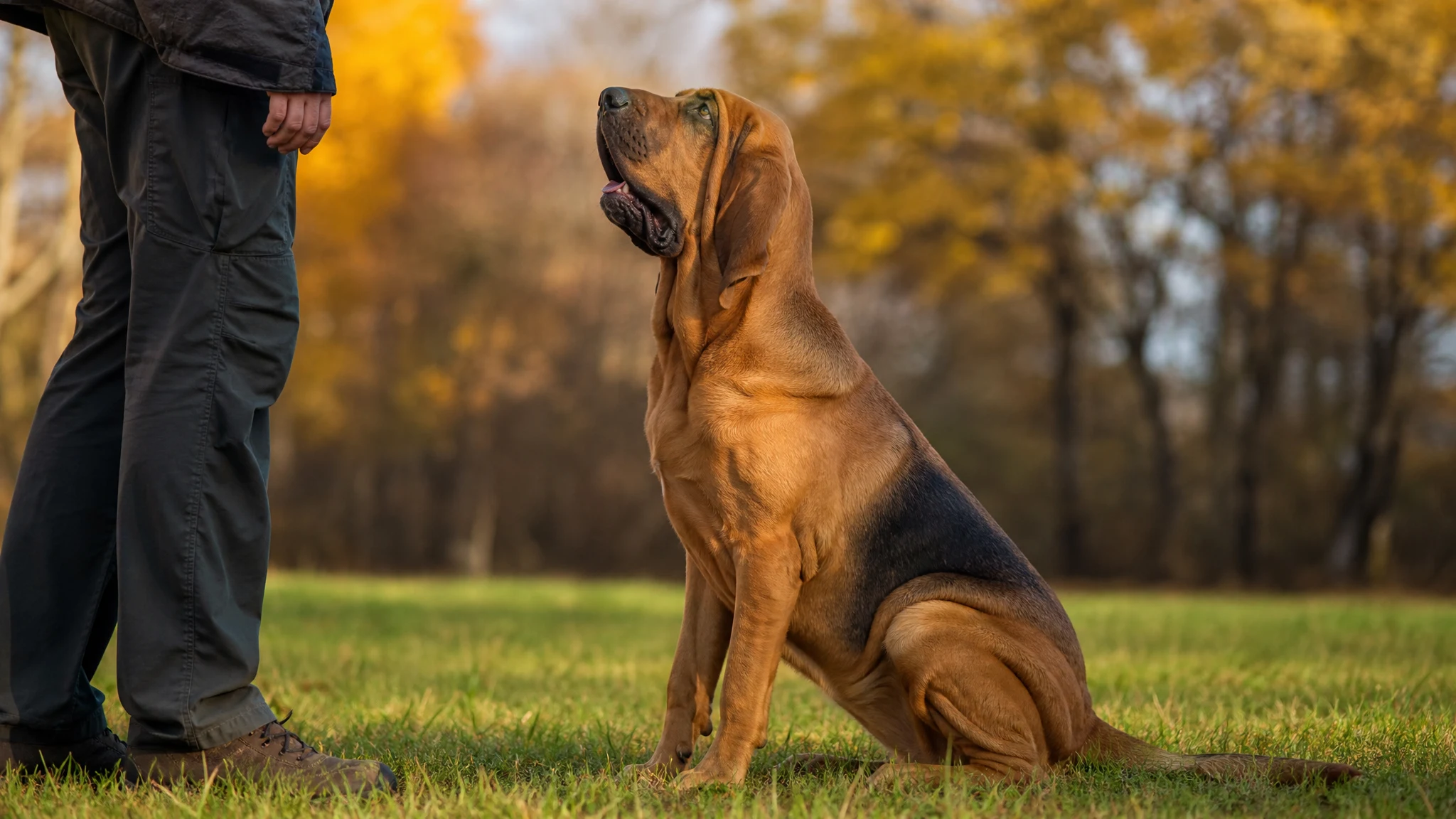
General training information. Every dog is an individual; for health or behavior concerns, see your veterinarian.
If you are working out how to train a Bloodhound, start with one idea. This is a dog built to follow its nose, and a lot of what looks like disobedience is the breed doing its job. Good Bloodhound training works with that nose instead of fighting it.
This guide covers what the breed was developed for, what its temperament means for lessons, the stages from puppy to adult, the rewards that tend to work, how to meet its exercise and mental needs, and the challenges worth planning for. It is written for people who love the breed, droopy ears and all, and want an honest picture.
One note on scope. Individual dogs vary, so treat breed traits as a starting point and not a promise. For anything about your dog's health or behavior that worries you, your veterinarian is the right first call.
Key takeaways
- The Bloodhound is a trailing scenthound. Its nose drives its behavior, so plan training around scent, not against it.
- PetMD describes the breed as independent thinkers that can be indifferent to training methods. Patience and positive reinforcement are the approach.
- Keep sessions short and frequent, and reward generously. Hill's Pet notes that harsh corrections backfire.
- Always use a leash or a secure fenced yard. PetMD warns that these dogs follow scents away.
- Loud baying is part of the breed and, per PetMD, typically cannot be trained out. Plan for it rather than expecting to remove it.
- Scent games and nosework count as real exercise and give the breed a legal outlet for its strongest instinct.
In this guide
- What the Bloodhound was bred for, and why it shapes training
- Temperament and trainability: what to expect
- Training stages from puppy to adult
- Motivation that works for this breed
- Exercise and mental work
- Challenges to plan for
- Sources
What the Bloodhound Was Bred For, and Why It Shapes Training
Every breed carries a job description in its genes. For the Bloodhound, the job is trailing by scent.
A scenthound with a long history
The United Kennel Club (UKC) says the Bloodhound traces its origins to the ancient French St. Hubert Hound. Hill's Pet gives a similar account, tracing the breed's ancestry to hounds bred at the St. Hubert Monastery. PetMD adds that the breed has a long history of assisting medieval nobles in tracking game.
You do not need to memorize the history. What matters is the pattern: for a very long time, this breed was valued for putting its nose down and staying on a trail. Dogs that did that well were the dogs people kept.
What that means in your living room
A dog shaped by that history is likely to find a scent far more interesting than you, your treats or your cheerful voice. That is not stubbornness for its own sake. It is a working instinct meeting a modern household.
Here is how it tends to show up in training:
- Distraction is constant. A walk is a reading session. Expect to stop often while your dog catches up on the neighborhood news.
- Recall is hard. Once the nose is on a trail, a call from you competes with something deeply rewarding.
- Focus has to be earned. Your dog will give you attention more readily when you make it worthwhile and when the environment is not overloaded with smells.
- Containment matters. PetMD says Bloodhounds must be leashed or kept in a secure fenced yard because they follow scents away.
Once you accept that the nose leads, training gets calmer. You stop asking why your dog will not listen and start asking how to make listening part of the scent game.
Size matters too
This is a big dog. PetMD lists the breed at 23 to 27 inches tall and 80 to 110 pounds, and Hill's Pet gives the same weight range. The UKC standard says the average adult male is about 26 inches and 90 pounds, with females averaging about 24 inches and 80 pounds.
A dog of that size that pulls toward a smell can pull hard. Loose-leash skills, calm greetings and polite manners are not extras. They are safety and quality-of-life skills, and they are easier to build while your dog is small.
Temperament and Trainability: What to Expect
The gentle side
The UKC breed standard describes the Bloodhound as gentle, placid, kind and sociable with people, and particularly attached to its owner. It also says the breed is never aggressive.
On family life, PetMD says Bloodhounds generally get along with children when socialized, and Hill's Pet says they tend to be patient with children. PetMD also notes that they love to be part of a pack and generally get along with other pets when socialized.
Notice the repeated phrase: when socialized. A friendly breed reputation does not replace good early exposure. Any dog this large needs to learn calm manners around people and other animals, and supervision around small children is wise with every dog.
The independent side
The same UKC standard says the breed may be somewhat reserved and stubborn. PetMD describes Bloodhounds as independent thinkers that can be indifferent to training methods, and says they need patience and positive reinforcement.
Read that carefully. It does not say the breed cannot learn. It says the breed will not necessarily work for the sake of pleasing you. Your dog may understand a cue perfectly well and still weigh it against everything else going on. Your job is to make the choice you want the easy, rewarding one.
Energy and noise
PetMD describes moderate daily exercise needs for the breed. Hill's Pet recommends at least an hour of daily physical activity. Both sources point toward a dog that needs regular outings and activity, not an extreme athlete, but also not a dog to leave bored at home.
On voice, PetMD calls the Bloodhound one of the most vocal breeds, with a deep howl or baying that typically cannot be trained out. If you live in an apartment or close to neighbors, think about this before you commit, and talk with neighbors early if you already have a dog.
For shedding, Hill's Pet rates the breed 3 on a 1 to 5 scale, and PetMD calls it a moderate shedder that needs weekly brushing, with heavier shedding twice a year. Grooming sessions double as handling practice, which helps with vet visits later.
Training Stages from Puppy to Adult
Specific developmental timelines vary by dog, and you should ask your veterinarian and your breeder or rescue about your own dog's stage. What follows is a practical order of operations built on reward-based methods, not a rigid calendar.
Stage 1: The first weeks at home
Your goals are simple: safety, routine and good associations.
- Set up a predictable day. Regular meals, potty breaks, naps and play help a puppy settle.
- Start potty training right away. Take your puppy out after sleeping, eating and play, and reward on the spot when it goes in the right place.
- Introduce the crate or a safe space. Make it comfortable and tied to good things like chews and rest.
- Begin gentle handling. Touch paws, ears, face and skin folds briefly, then reward. This pays off because the breed's ears and skin folds need regular care. PetMD and Hill's Pet both list ear infections as a common health issue, and PetMD lists skin fold dermatitis.
Stage 2: Socialization and foundation skills
Introduce your puppy to people, surfaces, sounds and settings at a pace it can handle. Keep experiences positive. If your puppy seems overwhelmed, increase distance and make things easier. Check with your veterinarian about when and where your puppy can safely go out, especially before vaccinations are complete.
Teach the basics in short, happy sessions:
- Name response. Say the name, reward eye contact.
- Sit and down. Lure with a treat, then reward the position.
- Come when called. Start indoors with no distractions. Make coming to you the best thing that happens all day.
- Loose leash basics. Reward position at your side and reward checking in.
- Settle on a mat. Reward calm behavior and build duration slowly.
Hill's Pet advises short sessions with several per day. That fits how this breed tends to work: a few minutes of focused, rewarded effort, then a break.
Stage 3: Adding distractions
Once a cue is reliable in the kitchen, take it to the yard, then a quiet street, then busier places. Change one thing at a time. If your dog stops responding, you moved too fast. Go back a step.
For a scent-driven dog, scent is the biggest distraction of all. Train in the same place with the same cues, then slowly allow more interesting smells nearby. Use a long line in unfenced areas so your dog can practice without being able to follow a trail away.
Stage 4: The adolescent months
Many owners find that a dog who seemed to know everything suddenly acts as though it has forgotten it all. This is common with adolescent dogs of any breed. With a breed described as independent, it can feel more pointed.
Stay consistent. Go back to easier criteria, raise the value of your rewards, shorten sessions if needed and keep exercise and mental work steady. Do not respond with harsh corrections. Hill's Pet says they backfire, and the AVSAB position supports reward-based training over aversive methods.
Stage 5: The adult dog
Adult training is maintenance plus enrichment. Keep practicing cues in new places, keep rewarding good choices, and keep giving your dog scent work and outings. PetMD and Hill's Pet both give a life expectancy of 10 to 12 years, so you have a long partnership to build on.
If you adopt an adult Bloodhound, the same order applies. Start with routine and trust, then rebuild the foundation skills with rewards, whatever the dog already knows.
Motivation That Works for This Breed
Reward-based training is the standard
Our training advice follows the American Veterinary Society of Animal Behavior (AVSAB), which favors reward-based methods. Both PetMD and Hill's Pet advise positive reinforcement and patience for Bloodhounds, and Hill's Pet notes that harsh corrections backfire.
That fits what we know of the breed. A dog described as reserved, independent and stubborn is unlikely to respond well to pressure. It is more likely to shut down or tune you out. We do not recommend shock, prong or choke collars, alpha rolls, scruffing or any dominance-based approach.
Using the nose as the reward
Food is a good motivator for many dogs, and small, soft, smelly treats are a sensible place to start. But with a scenthound, think beyond the treat bag.
- Scent as a reward. After a successful cue, release your dog to sniff a patch of ground or follow a short scent trail. For this breed, that may be worth more than a biscuit.
- Treat scatters. Toss a few treats into grass and let your dog hunt for them. It rewards the right behavior and feeds the instinct at the same time.
- Variety. Rotate rewards so none gets stale. Keep your best rewards for your hardest tasks, like recall.
Keeping it short and clear
Short sessions help any dog, and Hill's Pet specifically recommends several short sessions a day. End on a success, before your dog loses interest. A good rule is to stop while your dog still wants more.
Patience is a training tool
If your dog hesitates, wait. Many independent dogs need a moment to decide. Repeating a cue over and over teaches your dog that the first one does not count. Say it once, wait, and if needed help your dog get it right, then reward.
A simple recall game
Because recall is such a challenge for a trailing breed, build it as a game instead of a demand.
- Indoors, say your dog's name and a cue like come, then step back and reward when it arrives.
- Practice often, always with a reward worth running for.
- Move to the yard on a long line, still rewarding every arrival.
- Never call your dog to end the fun and then do something unpleasant, like a bath or leaving the park.
- Keep a long line or fence between your dog and open space, even when recall seems solid.
Given what PetMD says about the breed following scents away, treat recall as a skill that improves your odds, not as a replacement for a leash or secure fence.
Exercise and Mental Work
How much exercise
PetMD describes moderate daily exercise, such as long walks and outdoor play. Hill's Pet recommends at least an hour of physical activity each day. Plan on regular walks that are not rushed, plus some play in a secure area.
Because of the breed's size and history of heavy-bodied health concerns, ask your veterinarian about the right amount of activity for your own dog, especially for puppies and for dogs with joint trouble. PetMD and Hill's Pet both list hip and elbow dysplasia among the breed's common health issues. PetMD also lists gastric dilatation and volvulus (GDV, or bloat), so ask your veterinarian what precautions make sense around meals and exercise.
Make walks sniff-friendly
A walk does not have to be a march. For this breed, a slow walk where your dog is allowed to sniff is both exercise and mental work. Try a mix:
- Structured stretches where your dog walks at your side for rewards.
- Sniff breaks where you cue a release word and let your dog explore on a loose line.
- Varied routes so there is something new to smell.
Scent games and nosework
Hill's Pet says scent games and nosework count toward the breed's exercise. They are also a smart training tool, because they channel the strongest instinct into something you can control.
Easy home games:
- Find the treat. Hide treats around a room and let your dog search.
- Hide and seek. Have a family member hide with a treat and call your dog to find them.
- Scatter feeding. Spread a meal across the lawn or a snuffle mat.
- Short trails. Drag a treat along the ground to a hidden reward, making the path longer as your dog gains skill.
If you want organized scent activities, we do not have verified details on specific breed events or classes. Check with the American Bloodhound Club and with local clubs and trainers about what is available and what suits your dog.
Rest matters too
Teach your dog to settle. A mat, a crate or a bed with a chew gives your dog a place to relax after a busy outing. Practice calm behavior as often as you practice active skills.
Challenges to Plan For
The breed's gentle, sociable nature is a big part of its charm. But a good owner goes in with eyes open. Here are the main challenges described by PetMD, Hill's Pet and the UKC, and ways to prepare.
Following scents away
This is the big one. PetMD says Bloodhounds need a leash or a secure fenced yard because they follow scents away. Practical steps:
- Check fence height and look for gaps and places a determined dog could push through.
- Use a harness and leash on every outing outside the fence.
- Use a long line for practice in open areas.
- Make sure your dog wears an ID tag and ask your veterinarian about microchipping.
Independence and apparent indifference
PetMD says the breed can be indifferent to training methods, and the UKC says it may be somewhat reserved and stubborn. Expect slower progress on some skills than you might see in other breeds, and measure success by steady improvement, not speed.
If you feel stuck, make the task easier, raise the reward, shorten the session or change the setting. Consider working with a reward-based trainer. Ask any trainer you are considering about their methods, and walk away from anyone who recommends shock, prong or choke collars or dominance techniques.
Baying and howling
PetMD says the breed's deep howl or baying typically cannot be trained out. You can still manage it:
- Meet exercise and mental needs so boredom does not add to the noise.
- Reward quiet moments.
- Do not reward barking with attention, treats or release from the crate.
- Think seriously about your housing and neighbors before choosing the breed.
Handling and health care
Ears and skin folds need regular attention. PetMD and Hill's Pet list ear infections among common issues, and PetMD lists skin fold dermatitis. Hill's Pet also lists eyelid conformation disorders. Get your dog comfortable with being touched, checked and cleaned, and talk to your veterinarian about the right routine.
We do not have verified information on recommended health screenings for the breed. Ask your breeder which screenings they performed and check with your veterinarian and the American Bloodhound Club for current guidance.
Please do not try to diagnose problems yourself. If your dog seems uncomfortable, has changes in its ears, skin, eyes, appetite or belly, or shows sudden restlessness, call your veterinarian promptly.
Size and strength
An 80 to 110 pound dog, the weight range PetMD and Hill's Pet give, can be a handful on a leash if it has not learned manners. Start loose-leash training early, use a well-fitted harness or flat collar, and reward your dog for staying close. Teach calm greetings so your dog does not leap on visitors.
Time and patience
This is a breed that rewards steady, patient owners. Short daily sessions, steady routines and generous rewards add up. There are no guarantees in dog training, and every dog moves at its own pace, but a calm, consistent approach gives you the best chance of a relaxed, well-mannered companion.
Is it the right dog for you?
Before you commit, ask yourself:
- Do I have a secure fenced yard, or am I willing to leash walk every time?
- Can I live with a vocal dog?
- Do I have time for daily exercise of at least an hour, as Hill's Pet suggests, plus short training sessions?
- Am I comfortable with drool, ear care and skin fold care? Check with your veterinarian about what that routine involves.
- Can I stay patient and positive when progress is slow?
If you answered yes, you may be a good match for a breed that is gentle, sociable and devoted to its people.