How to Potty Train a Bloodhound Puppy
General training information. Every dog is an individual; for health or behavior concerns, see your veterinarian.
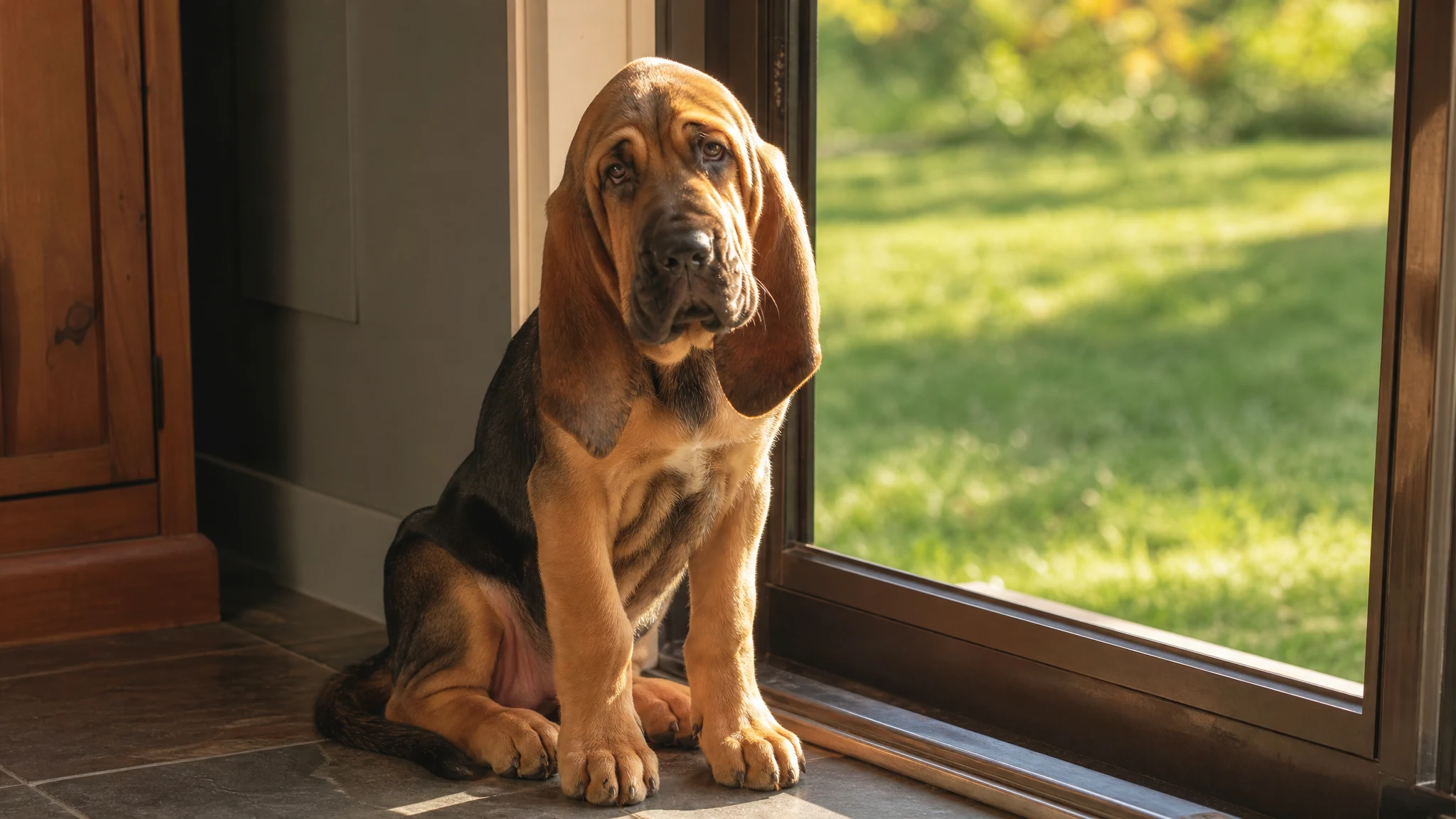
A Bloodhound puppy is mostly ears, wrinkles and nose, and that nose will have opinions about where your puppy wants to go. If you are wondering how to potty train a Bloodhound, the good news is that the basics are the same patient, reward-based routine that works for any puppy. The breed-specific part is how you apply it.
This guide walks through a schedule-based plan for house training a Bloodhound, how to use a crate well, what to do after accidents, and what to expect along the way.
What to Know About the Breed First
Bloodhound potty training goes better when you plan around the dog you actually have. A few points from the breed sources are worth keeping in mind.
- Size. PetMD lists adults at 23 to 27 inches tall and 80 to 110 pounds. The UKC breed standard gives an average adult male weight of 90 pounds. A puppy that large grows quickly, so set habits early, before the dog is too big to lift or guide easily.
- Independence. PetMD describes Bloodhounds as independent thinkers that can be indifferent to training methods, and says they need patience and positive reinforcement. The UKC standard notes the breed may be somewhat reserved and stubborn.
- Scent drive. PetMD says Bloodhounds follow scents away, so they need a leash or a secure fenced yard. That matters for potty breaks, because a puppy on a scent trail may forget why it went outside.
- Harsh corrections backfire. Hill's Pet says harsh corrections backfire with this breed. That fits the approach below, which never punishes accidents.
Individual dogs vary. Treat these as a starting picture, not a prediction. Neither PetMD, Hill's nor the UKC page gives a bladder-control timeline for the breed, so ask your veterinarian how long your own puppy can reasonably wait between trips.
Materials You Will Need
- A crate sized so the puppy can stand, turn around and lie down. Because Bloodhounds grow so large, many owners choose a crate with a divider so the space can expand as the puppy grows.
- A standard leash for every potty trip, even into a fenced yard at first. A longer lightweight line can help later, once your puppy reliably comes back to you.
- Small, soft treats that your puppy can swallow fast. Ask your veterinarian which treats suit your puppy.
- An enzyme-based cleaner made for pet accidents. Ordinary cleaners may leave a scent behind, and a Bloodhound's nose will find it.
- Paper towels and a few old towels for cleanup, since the breed's loose lips and wrinkles tend to pick up water and mess.
- A notebook or phone note to log meals, naps, potty trips and accidents.
- A designated potty spot in your yard, ideally quiet and easy to reach.
Step-by-Step: House Training a Bloodhound
Step 1: Pick a spot and a cue word
Choose one outdoor area and take your puppy there every time. The smell of earlier trips helps a scent-driven puppy understand the job. Pick a short cue such as "go potty" and use it in a calm voice as your puppy begins to go. Say it only then, so the words attach to the action.
Step 2: Build a predictable schedule
Puppies do best on a routine, and Hill's Pet suggests keeping sessions short and frequent for this breed, which suits potty training as well. Build the day around the moments when puppies most often need to go:
- First thing in the morning, before anything else.
- Right after meals.
- After waking from naps.
- After play or excitement.
- Right before bed, and again if your puppy wakes at night.
Feed at set times rather than leaving food out. A regular meal schedule tends to make potty times easier to predict. Ask your veterinarian what to feed and how often for your puppy. Between those key moments, take your puppy out on a regular rhythm, and shorten the gaps if you see accidents.
A sample day might look like this:
- Wake up, straight outside.
- Breakfast, then outside within a short time.
- Short play or training, then outside.
- Nap in the crate, then straight outside on waking.
- Repeat through the day, with meals and naps setting the pace.
- Last trip right before bedtime.
Step 3: Go out on a leash, every time
Walk your puppy to the spot on a leash and stand still. Resist the urge to wander. A Bloodhound puppy that finds a fascinating trail may start tracking instead of going. Stay boring for a couple of minutes. If your puppy sniffs in circles, that is often a good sign. If nothing happens, go back inside, put the puppy in the crate or on a tether near you for a short while, and try again soon.
PetMD notes that Bloodhounds must be leashed or kept in a secure fenced yard because they follow scents away. Treat that as a rule from day one, including at potty time.
Step 4: Reward right away
The moment your puppy finishes, praise calmly and give a treat. Timing is everything. Rewarding after you walk back inside is too late, because your puppy will not connect it to the potty. Deliver the treat at the spot. Then allow a little supervised sniffing or a short walk as an extra reward.
Because Bloodhounds can be indifferent to training, find what truly motivates your puppy. Some will work for a particular treat, some for a favorite game. Keep what works for potty success special and save it for that.
Step 5: Use the crate as a tool, not a punishment
Many puppies avoid soiling the place where they sleep, which is why a crate helps. Make it a happy place with a soft bed and an occasional treat tossed inside. Never use it as a punishment.
- Use the crate for naps and short periods when you cannot watch your puppy.
- Take your puppy straight outside when you let them out.
- Do not leave your puppy in the crate longer than it can reasonably wait. Ask your veterinarian for guidance on timing for your puppy's age.
- If your puppy cries, check whether it needs to go out rather than assuming it is fussing. At the same time, avoid making every whimper a party, or your puppy may learn that noise brings attention.
PetMD describes Bloodhounds as one of the most vocal breeds, with a deep howl or baying that typically cannot be trained out. Expect some noise from the crate. Plan for it, and do not be discouraged by it.
Step 6: Supervise indoors
When your puppy is out of the crate, keep it where you can see it. Use baby gates, a leash tethered to you, or a small play area. Most accidents happen when no one is watching. Learn your puppy's signals, such as sniffing the floor, circling, whining or heading for a corner, and go outside the moment you see them.
Step 7: Handle accidents without punishment
Accidents will happen. How you respond decides whether training moves forward. Never scold, yell, rub a nose in a mess or use any physical correction. Hill's Pet says harsh corrections backfire with the breed, and reward-based methods are in line with the position of the American Veterinary Society of Animal Behavior.
Instead:
- If you catch your puppy mid-accident, calmly interrupt with a neutral sound and carry or lead them outside.
- If it finishes outside, praise and treat.
- If you find the mess later, clean it quietly. Your puppy cannot connect it to something that happened earlier.
- Use an enzyme-based cleaner so the scent does not invite a repeat.
- Ask yourself what went wrong. Was the gap too long? Was supervision lacking? Adjust the schedule.
A puppy that hides to go may have learned that going in front of you is unsafe. If you see that, return to calm, reward-heavy training and more supervision.
Step 8: Expand freedom slowly
As your puppy has fewer accidents, give more room, one space at a time. If accidents return, step back to the previous level. Progress is rarely a straight line, and that is normal.
Tips for Success with a Scent-Driven Breed
- Keep sessions short and upbeat. Hill's Pet recommends multiple short sessions a day. The same idea works for practicing the potty routine.
- Make the outdoor spot interesting but not too interesting. A quiet corner beats a spot with fresh animal trails.
- Be consistent as a household. Everyone should use the same spot, cue and rewards.
- Use the nose. Hill's Pet says scent games and nosework count toward exercise. A brief scent game after a successful potty trip can be a fun reward.
- Stay patient. PetMD describes the breed as needing patience and positive reinforcement. A slow day is not a failure.
- Cover the daily needs. Hill's Pet lists at least an hour of daily physical activity, while PetMD describes moderate exercise. A tired, satisfied puppy is usually easier to train.
Common Mistakes to Avoid
- Punishing accidents. It tends to teach a puppy to hide, not to go outside.
- Skipping the leash. A free-roaming puppy may follow a scent and forget the task.
- Waiting too long between trips. Short gaps prevent accidents, and prevention is the core of the plan.
- Rewarding late. The treat must arrive at the spot, within moments.
- Giving too much freedom too soon. A big house is a lot of territory for a puppy.
- Using harsh tools or dominance methods. They are not part of reward-based training and the sources above say harsh corrections backfire.
- Ignoring health. Frequent accidents, straining or sudden changes in a trained dog are a reason to call your veterinarian rather than assume it is a training problem.
How Long Does It Take?
There is no reliable timeline for this breed. None of the breed sources used for this article gives a figure for how long house training takes, so treat any exact number you see elsewhere with caution. Puppies differ in age, routine, health and temperament, and a Bloodhound's independent streak, which PetMD and the UKC both mention, may make progress feel slower on some days.
What you can reasonably expect is gradual improvement. With a steady schedule, close supervision and consistent rewards, many puppies have fewer accidents over the following weeks. Setbacks during growth spurts, changes at home or excitement are common. If progress stalls or you are worried, ask your veterinarian to rule out a health cause, and consider a certified positive-reinforcement trainer for hands-on help.
A Note on Health and Potty Habits
PetMD and Hill's Pet list several health concerns in the breed, including ear infections, skin fold dermatitis and gastric dilatation and volvulus, often called bloat. None of these is a training issue, and this article cannot diagnose your dog. If your puppy seems uncomfortable, has a swollen belly, is retching without producing anything, or its potty habits change suddenly, contact your veterinarian promptly.
Quick Recap
- Choose one spot and one cue.
- Build a schedule around meals, naps, play and bedtime.
- Go out on a leash every time and stay boring.
- Reward immediately at the spot.
- Use the crate as a comfortable resting place, not a punishment.
- Supervise whenever your puppy is loose.
- Meet accidents with calm cleanup, never punishment.
- Increase freedom slowly.
Bloodhound potty training rewards the owner who stays calm and consistent. Your puppy's nose will always be working, so give it a clear job: finding the right spot, going, and collecting the reward.