Bloodhound Puppy Training Timeline: 8 Weeks to 2 Years
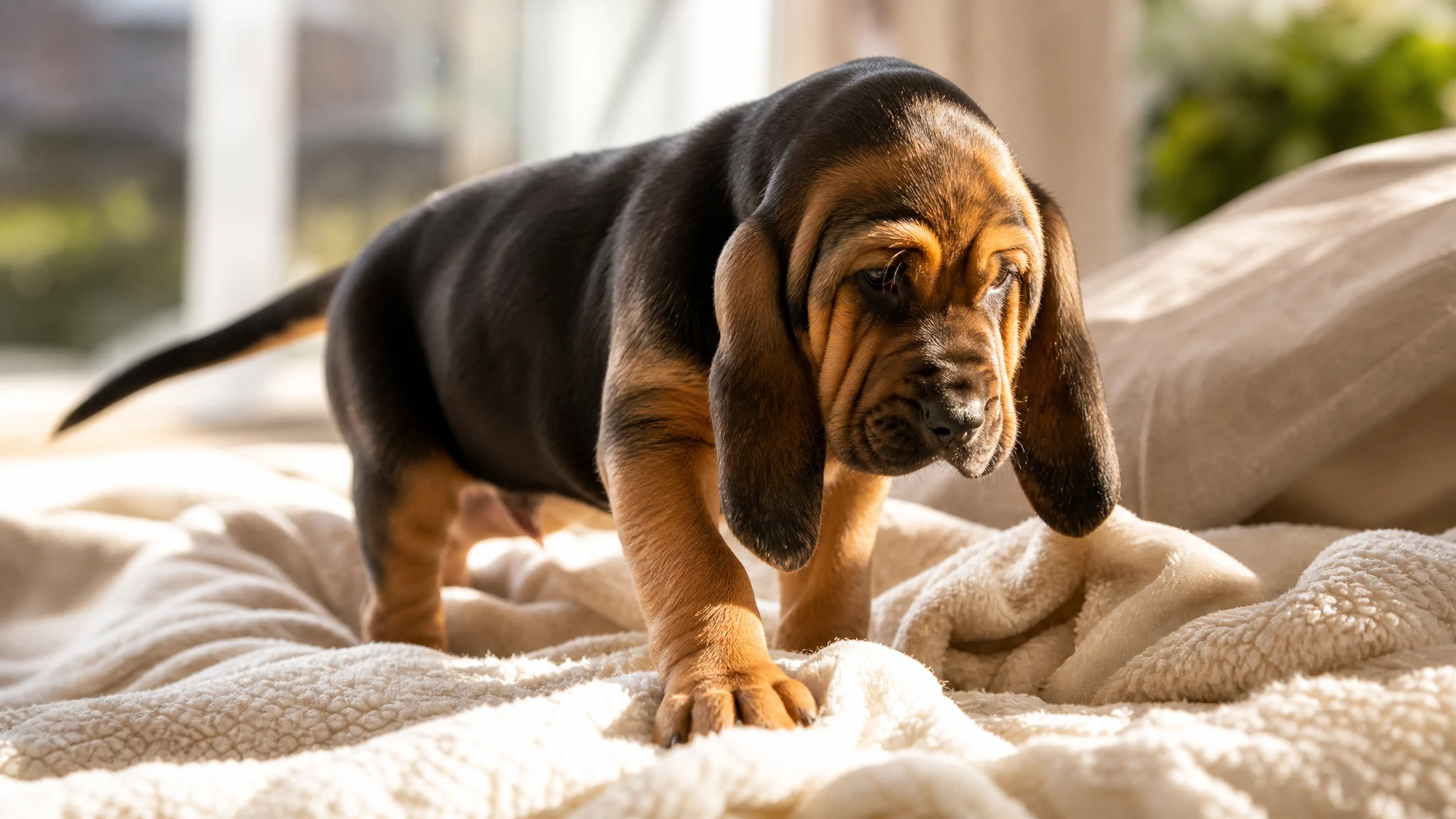
General training information. Every dog is an individual; for health or behavior concerns, see your veterinarian.
A Bloodhound puppy arrives with big ears, loose skin, a nose that never stops working and a deep, confident voice. Training one is a joy and a test of patience, often in the same afternoon. This guide lays out a practical bloodhound puppy training schedule, stage by stage, from the first week home to the second birthday.
Every dog grows at their own pace. Treat the ages below as a planning frame, not a deadline. Where the breed itself matters, we lean on what the United Kennel Club (UKC), PetMD and Hill's Pet say about Bloodhounds. Where those sources are silent, we tell you to ask your breeder, your veterinarian or the American Bloodhound Club.
Table of Contents
- Key takeaways
- What to expect from the breed
- Weeks 8 to 12: settling in and early socialization
- Months 3 to 5: house training, bite inhibition and manners
- Months 6 to 12: adolescence and the scent-drive years
- Months 12 to 24: maturity and polish
- Protecting growing joints, ears and skin
- Troubleshooting and sources
Key Takeaways
- PetMD describes Bloodhounds as independent thinkers who can be indifferent to training methods. Plan for patience and rewards.
- Hill's Pet advises short sessions, several times a day, with positive reinforcement. Harsh corrections backfire.
- PetMD says the Bloodhound is one of the most vocal breeds, and the deep baying typically cannot be trained out. Train around it, not against it.
- Scent drive means a leash or a secure fence at all times, according to PetMD.
- Hip and elbow dysplasia appear on the health lists from both PetMD and Hill's, so ask your veterinarian how much exercise suits a growing puppy.
- Our sources do not give a month-by-month development chart or a maturity age for the breed. Ask your breeder, veterinarian and the American Bloodhound Club for those details.
What to Expect from the Breed
Good bloodhound puppy training starts with knowing what the breed was made to do. The UKC says the Bloodhound traces its origins to the ancient French St. Hubert Hound. Hill's Pet traces its ancestry to hounds bred at the St. Hubert Monastery. PetMD describes a long history of helping medieval nobles track game. This is a trailing scenthound, and that job shapes everything about how the dog learns.
Temperament in the breed standard
The UKC standard calls the Bloodhound gentle, placid, kind and sociable with people, and particularly attached to its owner. It also says the breed may be somewhat reserved and stubborn, and never aggressive. PetMD adds that Bloodhounds generally get along with children and other pets when socialized, and Hill's says they tend to be patient with children.
Those are breed-level descriptions. Your puppy is an individual, so watch the dog in front of you.
Size, exercise and lifespan
PetMD lists a height of 23 to 27 inches and Hill's and PetMD both list 80 to 110 pounds for adults. The UKC standard gives an average adult male height of 26 inches and an average weight of 90 pounds, with females averaging 24 inches and 80 pounds. PetMD and Hill's both give a life expectancy of 10 to 12 years.
That adult size is the reason to train early. A puppy who pulls on a leash today will be pulling with a lot more weight later.
PetMD describes moderate daily exercise, and Hill's recommends at least an hour of daily physical activity. Hill's notes that scent games and nosework count toward that time.
Why rewards work better
A dog bred to follow a trail for long stretches is not built to hang on your every word. Food, play and the chance to use the nose are the currencies that keep a Bloodhound engaged. Reward-based methods are also the approach supported by the American Veterinary Society of Animal Behavior (AVSAB). Skip shock, prong and choke collars, alpha rolls, scruffing and any dominance-based advice. They add fear and do nothing for a dog who is simply following a scent.
Weeks 8 to 12: Settling In and Early Socialization
The first month at home sets the tone. Your goals are modest: a safe routine, calm handling, happy first experiences and a few basic cues.
Build a predictable day
Puppies learn fastest when life is predictable. Pick set times for meals, potty breaks, play, naps and bedtime. A crate or a puppy pen gives your pup a safe place to rest, and it makes house training far easier. Introduce it with treats and chews so it feels like a good place, never a punishment.
Ask your veterinarian about the feeding schedule and portion sizes. PetMD lists gastric dilatation and volvulus (GDV, or bloat) among the breed's health concerns, so mealtime routines are worth a conversation at the first checkup.
The socialization window
Early socialization means pairing new sights, sounds, surfaces and people with good things. Our breed sources do not give exact dates for when this window opens and closes in Bloodhounds, so ask your veterinarian for timing and for advice on balancing vaccination status with safe outings.
In the meantime, plenty can happen at home and in controlled settings:
- Let your puppy walk on tile, grass, carpet and gravel.
- Play recordings of doorbells, vacuum cleaners and traffic at low volume while feeding treats.
- Invite calm, vaccinated, friendly adults and dogs for short visits.
- Handle paws, ears, lips and skin folds gently, then reward. Bloodhounds need regular ear and skin checks, so this practice pays off.
PetMD says Bloodhounds generally get along with other pets and children when socialized. The word "when" matters. Socialization is work you do, not something that happens by default.
First cues to teach
Keep each session to a few minutes. Hill's recommends short sessions several times a day, which suits a puppy's attention span.
- Name response. Say the name, reward when your puppy looks at you.
- Sit. Lure with a treat over the nose, then reward when the bottom touches down.
- Come. Run backward, call cheerfully and reward big. Never call your puppy to you for something unpleasant.
- Settle on a mat. Reward calm behavior on a blanket, then build duration slowly.
Months 3 to 5: House Training, Bite Inhibition and Manners
Between roughly three and five months, most of the foundation work in a bloodhound puppy training schedule comes together. Habits form quickly at this age, good and bad.
House training that sticks
House training is about management and timing, not scolding. Take your puppy out on a regular rhythm:
- First thing in the morning and last thing at night
- After every meal, nap and play session
- Every hour or two while awake, at first
Go to the same spot, wait quietly, and reward within seconds of finishing. Scenthounds love to sniff before they go, so give your puppy a minute to read the ground. Supervise indoors, or use the crate or pen when you cannot watch. If an accident happens, clean it with an enzymatic cleaner and move on. Punishing a puppy after the fact only teaches them to hide.
Expect setbacks. Every puppy has them, and the timeline varies. If house training seems stuck or your puppy has frequent accidents, ask your veterinarian to rule out a health cause.
Bite inhibition
Puppies explore with their mouths. The goal is not to stop mouthing overnight but to teach a soft mouth and redirect the rest.
- Offer a chew or toy whenever teeth touch skin.
- If the biting continues, calmly end the play and step away for a short pause. Return when your puppy settles.
- Reward gentle licking and soft mouths with attention.
- Avoid rough wrestling and hand games that teach your pup that skin is fair game.
Do not pin, flick or hold the muzzle shut. These dominance-style tactics are the opposite of what AVSAB supports, and they can make a puppy more mouthy or fearful.
Leash skills and the howl
PetMD says Bloodhounds need to be leashed or in a secure fenced yard because they follow scents away. Start leash work early. Use a well-fitted flat collar or a harness, and reward your puppy for staying near you. Let your dog have sniffing breaks as a reward for loose-leash walking. A "go sniff" cue turns the breed's strongest instinct into a training tool.
On voice, PetMD calls the breed one of the most vocal and says the deep howl or baying typically cannot be trained out. You can still teach your puppy that quiet moments earn rewards, and you can prevent boredom, which fuels a lot of noise. Warn your neighbors, and plan for it if you live in an apartment or shared housing.
Handling and husbandry practice
Teach your puppy to accept brushing, ear checks, nail trims and towel drying. PetMD notes a moderate shedder with weekly brushing and heavier shedding twice a year. Hill's rates shedding a 3 on a 1 to 5 scale. Short, happy grooming sessions now make adult care easier.
Months 6 to 12: Adolescence and the Scent-Drive Years
Many owners notice a change around six months. Your once-agreeable puppy may stop listening, wander off on a trail or seem to forget cues they knew well. This is normal adolescent behavior in dogs generally, and the UKC's note that Bloodhounds may be somewhat reserved and stubborn fits the picture. Keep calm and keep going.
Keep rewards high and sessions short
PetMD describes Bloodhounds as independent and indifferent to training methods. In adolescence, that independence gets louder. Raise the value of your rewards, practice in short bursts and end on a success. Hill's cautions that harsh corrections backfire, and that is especially true when a teenager is testing boundaries.
Proof your recall
A reliable recall is hard for any scenthound, and a Bloodhound with a nose full of trail is harder still. PetMD says the breed must be leashed or kept in a secure fenced yard. Use a long, light line in open spaces, and do not trust off-leash freedom in an unfenced area. Practice recalls at increasing distances and distractions, and always pay well.
Use the nose as a job
Hill's says scent games and nosework count toward daily activity. Try these at home:
- Scatter a few treats in the grass and let your puppy hunt.
- Hide a toy in one room and send your dog to find it.
- Lay a short, simple trail with treats and increase the length over time.
Our sources do not list specific dog sports or working roles for the breed. If you want to try trailing or nosework classes, ask the American Bloodhound Club or local instructors which programs are available and how they recommend starting.
Keep social experiences going
Do not stop socializing when the early window ends. Keep introducing new places, people and surfaces at a pace your dog enjoys. If your adolescent seems unsure, give distance and a treat. Do not force greetings.
Months 12 to 24: Maturity and Polish
The last stretch of the timeline is about consistency. Our breed sources do not state the age at which a Bloodhound is fully mature, either physically or mentally. Ask your breeder and veterinarian what to expect for your dog, and keep training as though maturity is still arriving.
Turn skills into habits
By the second year, you are polishing rather than building. Work on these:
- Loose-leash walking in busier places
- Stay and wait at doors, car exits and curbs
- Calm greetings with guests and children
- Recall on a long line with real distractions
- Settling in cafes, vet waiting rooms and friends' homes
A realistic adult routine
PetMD calls for moderate daily exercise such as long walks and outdoor play, and Hill's says at least an hour a day. Combine walks with sniffing time and a scent game or two. A mentally tired Bloodhound is easier to live with than one who is only physically tired.
Keep the learning alive
Adult dogs still benefit from refresher sessions. A few minutes a day of cues, tricks or nosework keeps your bond strong and your dog engaged. If you plan to try a class or club activity, choose instructors who use reward-based methods and let the dog work at their own pace.
Protecting Growing Joints, Ears and Skin
Training and health go together. PetMD and Hill's both list hip and elbow dysplasia among the breed's common health issues. Neither source gives a puppy exercise formula, so the safest step is to ask your veterinarian what is appropriate at each age.
Joint-friendly habits
These are common-sense ideas to discuss with your veterinarian:
- Choose steady walks and sniffing over repetitive, high-impact exercise.
- Avoid asking a young puppy to jump from furniture or vehicles. Use ramps or lift your pup when you can.
- Give traction on slippery floors with rugs or mats.
- Keep your dog lean, since extra weight puts extra load on joints. Your veterinarian can tell you what a healthy body condition looks like.
Ears, skin folds and eyes
PetMD and Hill's list ear infections from floppy ears. PetMD also lists skin fold dermatitis, and Hill's lists eyelid conformation disorders. Make ear, fold and eye checks part of your weekly handling practice, and reward calm behavior. If you see redness, odor, discharge or squinting, call your veterinarian. Do not try to diagnose or treat at home.
Bloat awareness
PetMD lists GDV among the breed's concerns. Ask your veterinarian how to set up feeding and activity routines, and what warning signs mean an emergency visit.
Our sources do not list recommended health screenings for Bloodhounds. Ask your breeder which tests they perform on parents, and check with your veterinarian and the American Bloodhound Club for current guidance.
Troubleshooting and Sources
Quick answers
| Challenge | What the sources say | Reward-based approach |
|---|---|---|
| Ignores cues outdoors | PetMD: independent, indifferent to training methods | Higher-value treats, shorter sessions, a long line |
| Follows scents away | PetMD: needs a leash or secure fence | Long line, "go sniff" cue, scent games |
| Loud baying | PetMD: typically cannot be trained out | Prevent boredom, reward quiet, warn neighbors |
| Mouthy puppy | Hill's: positive reinforcement and patience | Redirect to chews, brief pauses, no rough play |
| Stalled progress in adolescence | UKC: may be somewhat reserved and stubborn | Go back a step, keep sessions short, end on a win |
A simple weekly rhythm
Many owners find a loose weekly pattern helpful. It is a sample, not a rule:
- Daily: three or four short training bursts, potty routine, one scent game
- Several times a week: leash practice in a new location
- Weekly: full grooming and ear, fold and eye check, plus one calm social outing
When to get help
Reach out to a qualified, reward-based trainer if you run into fear, guarding or persistent trouble. Ask your veterinarian first if a behavior change seems sudden, since pain or illness can be behind it. Look for instructors who follow AVSAB-aligned, humane methods.
Final thoughts
A Bloodhound will not train like a retriever, and that is part of the charm. The UKC describes a gentle, sociable dog who is attached to their person. Meet that dog with patience, rewards and plenty of chances to use the nose, and the timeline from eight weeks to two years becomes a long, rewarding partnership. Individual dogs vary, so adjust the schedule to your puppy.