How Much Exercise Does a Bloodhound Need? Plus Brain Games
General training information. Every dog is an individual; for health or behavior concerns, see your veterinarian.
Bloodhounds are big, droopy and lovable. They are also scenthounds, and that shapes everything about how they spend their day. Ask how much exercise a Bloodhound needs and the honest answer has two parts: some physical movement and a good deal of nose work.
This guide gives you a simple daily plan. It covers walks, scent games and puzzle feeders, and it points out the mistakes that trip up many new owners. For the bigger picture on manners and obedience, see our complete guide to Bloodhound training.
How Much Exercise Does a Bloodhound Need?
PetMD describes the Bloodhound as needing moderate daily exercise, such as long walks and outdoor play. Hill's Pet is a little more specific and says to plan for at least an hour of physical activity each day. Hill's also notes that scent games and nosework count toward that time.
So a reasonable target for a healthy adult is about an hour a day, split into two or three outings. Think steady and sniffy rather than fast and frantic. Individual dogs vary, so adjust to your own hound and talk with your veterinarian about what suits their body.
Size matters for planning
PetMD lists the breed at 23 to 27 inches tall and 80 to 110 pounds. The United Kennel Club (UKC) standard gives an average adult male of about 26 inches and 90 pounds, and an average adult female of about 24 inches and 80 pounds. That is a lot of dog on a leash, so build your routine around control and safety as well as fun.
Exercise by Life Stage
The sources we rely on give daily exercise guidance for the breed overall. They do not give exact minutes for puppies or seniors, so use the points below as common-sense framing and let your vet set the specifics.
Puppies
PetMD and Hill's both list hip and elbow dysplasia among the breed's common health issues. That is a good reason to be gentle with a growing puppy's joints. Ask your veterinarian how long and how hard your puppy's outings should be, and avoid forced running, long hikes and repeated jumping until your vet says the joints are ready.
Short, easy sessions work well. Several brief sniff walks and a few minutes of training are a better fit for a puppy than one long march. Check with your breeder or the American Bloodhound Club for any breed-specific puppy guidance.
Adults
Adults sit in the range above: moderate daily exercise, with Hill's suggesting at least an hour. Mix leashed walks, secure yard play and scent work. Keep the pace relaxed, since this breed was built to follow a trail rather than sprint.
Seniors
PetMD and Hill's both give a life expectancy of 10 to 12 years. As your hound gets older, ask your vet whether to shorten walks or switch to gentler surfaces. Sniffing is easy on the body, so scent games can stay a big part of the day.
Why the Nose Comes First
UKC says the Bloodhound traces its origins to the ancient French St. Hubert Hound, and Hill's traces the ancestry to hounds bred at the St. Hubert Monastery. PetMD notes a long history of helping medieval nobles track game. In short, this is a trailing scenthound.
That original job explains why a quick lap around the block rarely satisfies the breed. Letting your dog use the nose is part of the exercise, not a delay in it.
Materials You Will Need
- A well-fitted flat collar or a front-clip or back-clip harness, plus an ID tag
- A standard leash and a longer leash for sniff walks
- A securely fenced yard, or a leash at all times outdoors
- Small, soft treats your dog loves
- A puzzle feeder, snuffle mat or muffin tin and tennis balls
- Cardboard boxes, towels and a few old socks or toys for scent games
- Fresh water and a towel for wiping the face and ears after outings
Step-by-Step: A Daily Plan
Step 1: Secure your setup first
PetMD says Bloodhounds must be leashed or in a secure fenced yard because they follow scents away. Walk your fence line and check for gaps, loose boards and spots a determined hound could dig under. Outside the fence, keep the leash on.
Step 2: Start with a sniff walk
On a long leash, pick a quiet route and let your dog lead the way for part of the outing. Stand still while your hound reads the grass, the posts and the corners. Move on when the dog is ready, or when you need to.
A sniff walk might cover less ground than a brisk power walk. Many owners find the dog seems more settled afterward, though results vary from dog to dog.
Step 3: Add a structured walk
Next, do a calmer stretch on a shorter leash with loose-leash manners. Reward your dog with a treat each time the leash stays slack beside you. Release the dog to sniff again as the reward. This teaches that good walking earns nose time.
Step 4: Break up the day
Hill's recommends short training sessions, several times a day. Aim for two or three outings and a few brief brain games, rather than one marathon. Keep each training session to a few minutes and end while your dog is still keen.
Step 5: Feed from a puzzle
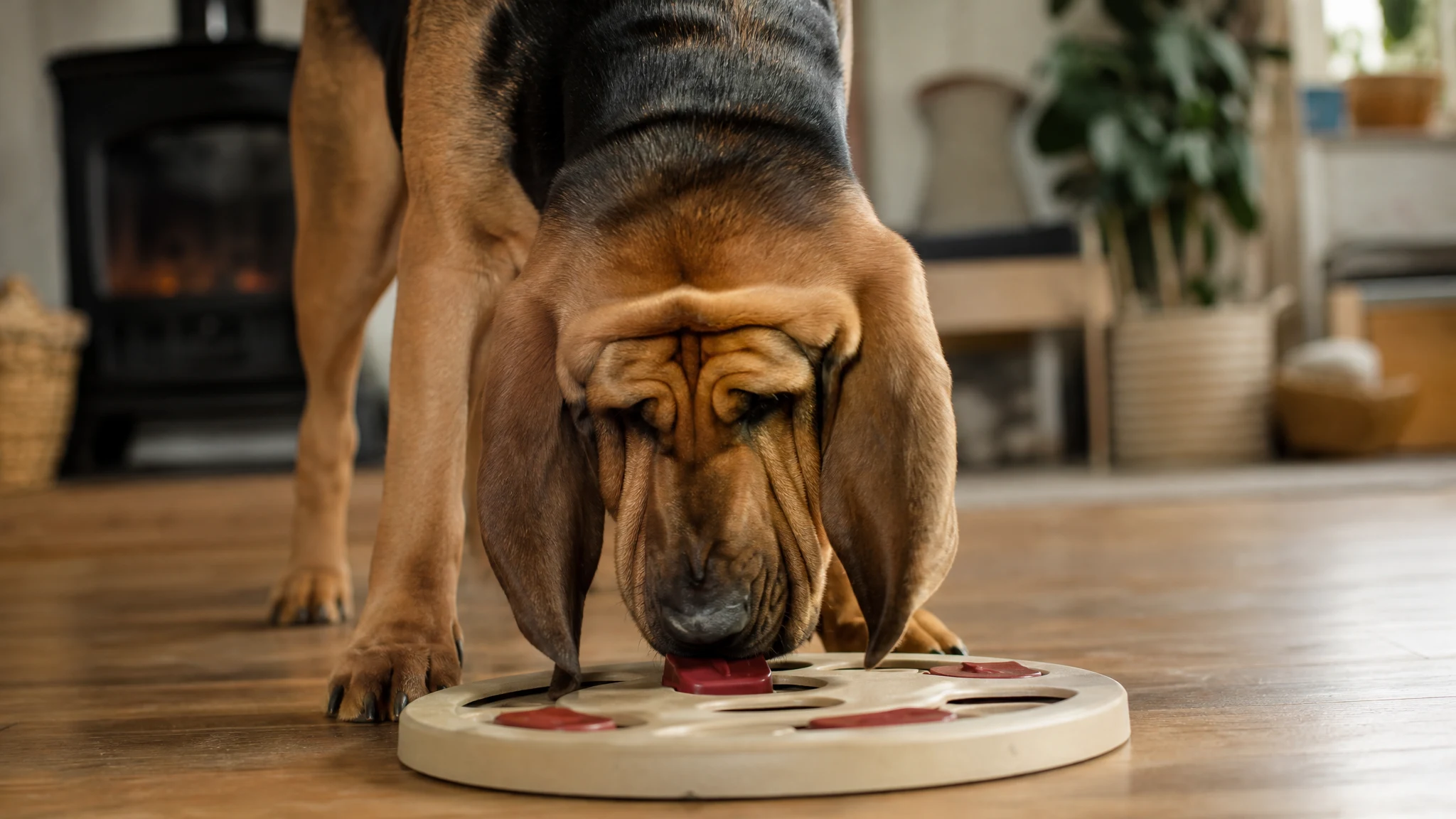
Swap the bowl for a puzzle feeder or snuffle mat for at least one meal. Scatter-feeding kibble in the grass works too. Start easy so your dog wins early, then raise the difficulty slowly. This is simple bloodhound mental stimulation that uses the nose for the whole meal.
Step 6: Play a scent game
Choose one of the games below and play it most days. Details follow in the next section.
Step 7: Wind down
Finish with a calm chew or a rest on a mat. Wipe the face and check the ears and skin folds. PetMD and Hill's list ear infections, and PetMD lists skin fold dermatitis, among the breed's common problems, so bring any redness, odor or discomfort to your veterinarian.
Brain Games That Match the Trailing Job
Good bloodhound mental stimulation borrows from what the breed was made to do: find a scent and follow it. All of these games use treats and praise only, in line with reward-based methods recommended by the American Veterinary Society of Animal Behavior (AVSAB).
Find the treat
Ask your dog to wait, or have a helper hold the leash. Hide a few treats in easy spots around one room, then say a cue like "find it." Praise when your dog locates each one. Over a few days, move to harder spots such as behind a chair leg or under a towel.
Muffin tin shuffle
Place treats in some cups of a muffin tin and cover each cup with a tennis ball. Let your dog work out which balls to nudge aside. Supervise so no one chews on the balls or the tin.
Box search
Line up three or four open cardboard boxes. Put a treat in one and let your dog check them. Add more boxes as your dog improves. This teaches the dog to keep working a search until something is found.
Short trail game
Have a helper drag a treat or favorite toy a short way across the grass and hide it, while your dog waits out of sight. Bring the dog out on a long leash and let the nose do the rest. Start with a very short, straight trail and lengthen it little by little. Always keep the leash on, because this is the exact sort of game that tempts a hound to wander.
Name the toy
Teach the names of two or three toys by saying the name as your dog picks one up, then rewarding. This adds a thinking game to the day without needing any space.
Tips for Success
- Keep sessions short. Hill's advises short sessions, several per day.
- Be patient. PetMD describes the breed as independent and sometimes indifferent to training methods, and UKC says it may be somewhat reserved and stubborn. Use high-value treats and go at your dog's speed.
- Rotate games. Changing the puzzle or the hiding spot keeps the work interesting.
- Socialize. PetMD says the breed generally gets along with children and other pets when socialized. Calm, planned introductions help.
- Ask about mealtimes. PetMD lists gastric dilatation and volvulus (bloat) among the breed's health concerns. Ask your veterinarian how to time meals and exercise.
- Use the cue "leave it" and a reliable recall. Practice indoors first. Even so, do not trust recall near distractions.
Common Mistakes to Avoid
- Letting the dog off leash. A strong scent can pull a Bloodhound far away fast. Stay on leash or in a secure fence.
- Skipping the brain work. Walks alone may not use up what a scenthound has to give. Add nose games.
- Harsh corrections. Hill's and PetMD both say harsh methods backfire. Do not use shock, prong or choke collars, or any force-based method. Reward the behavior you want instead.
- Overdoing it with a puppy. Because of the joint concerns listed above, check limits with your vet.
- Expecting the baying to disappear. PetMD calls the breed one of the most vocal and says the deep howl or baying typically cannot be trained out. Extra exercise and enrichment may help your dog feel more settled, but plan for some noise and talk to neighbors if needed.
- Rushing the sniff. Dragging a hound away mid-scent can turn walks into tug-of-war. Build in regular release moments.
What Results to Expect
With a steady routine of walks, puzzle meals and scent games, many owners notice that their hounds seem calmer and more content at home. Some dogs may chew less or settle faster after a good sniff session. These changes are not guaranteed and depend on your dog's age, health and personality, and how consistent you are.
Give any new routine a few weeks before judging it. If your dog seems restless, destructive or sore, or if you see limping, stiffness or a swollen belly, contact your veterinarian right away. Exercise questions about health always belong with a vet.
Putting It Together
A sample day for a healthy adult might look like this: a sniff walk in the morning, breakfast from a puzzle feeder, a short training session at midday, a structured walk in the afternoon, and a scent game in the evening. Adjust the order and length to your dog and your schedule.
The core idea is simple. Give a Bloodhound daily movement, plenty of time to use that famous nose, and patient, reward-based teaching. Then build from there with your vet's guidance.