Leash Training a Bloodhound: Pulling, Lunging and Loose-Leash Walking
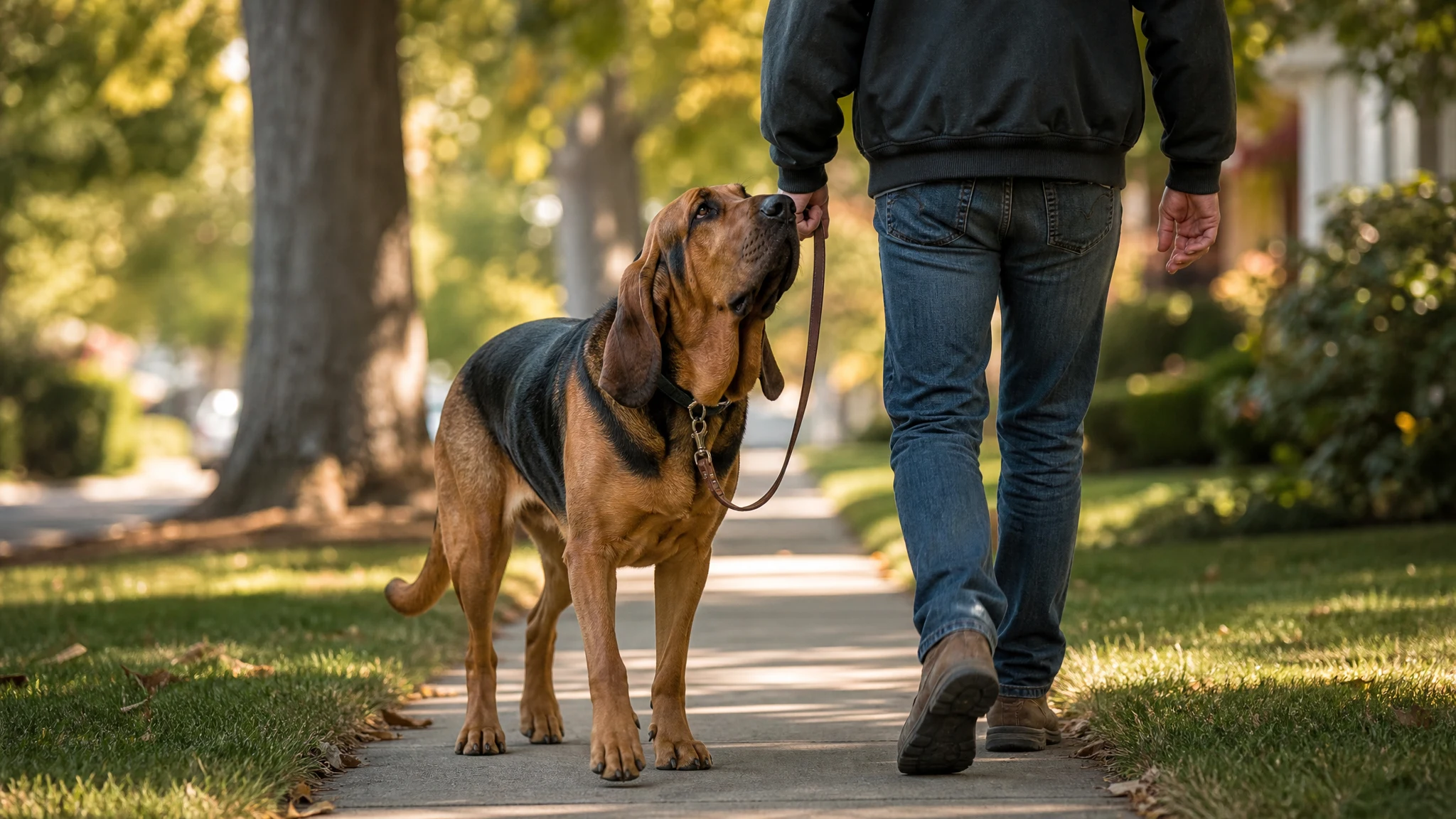
General training information. Every dog is an individual; for health or behavior concerns, see your veterinarian.
Walk a Bloodhound and you will quickly learn who is steering. The nose goes down, the shoulders lean in, and 80 to 110 pounds of determined hound heads for whatever smells most interesting. If you are searching for how to leash train a Bloodhound, the good news is that it can be done. The honest news is that it takes patience, short sessions and realistic goals.
This guide covers why Bloodhounds pull, the gear that helps, a step-by-step plan for loose-leash walking, and what to do when your dog lunges. For the bigger picture, see our complete guide to Bloodhound training.
Why Bloodhounds Pull
Bloodhound pulling on leash is rarely stubbornness for its own sake. It comes from what the breed was built to do. The United Kennel Club (UKC) says the breed traces its origins to the ancient French St. Hubert Hound, and PetMD describes a long history of helping medieval nobles track game. This is a trailing scenthound.
PetMD notes that Bloodhounds follow scents away, which is why they need to be leashed or kept in a secure fenced yard. A scent trail is the most rewarding thing in the world to this dog. A walk is basically a buffet.
Two more traits matter for leash work. PetMD describes Bloodhounds as independent thinkers that can seem indifferent to training methods. The UKC standard says the breed may be somewhat reserved and stubborn. Individual dogs vary, but expect to be persuasive rather than forceful.
Size matters too. The UKC standard gives an average adult male weight of 90 pounds, up to 110, and females average 80. Teach good habits early, while the dog is still easy to hold.
Materials You Will Need
- A flat collar that fits snugly enough not to slip over the head, with ID tags.
- A front-clip harness (optional but useful). The leash clips at the chest, which turns the dog back toward you when it leans forward. Have it fitted properly so it does not rub.
- A sturdy 6-foot leash. Choose one with a comfortable grip. Skip retractable leashes, which teach a dog that pulling extends the leash.
- A longer line (15 to 20 feet) for sniffing time in safe, open areas.
- Small, soft, smelly treats. Tiny pieces of something your dog loves. Cut them pea-sized so you can use many.
- A treat pouch so rewards are quick to reach.
What not to use: prong collars, choke collars and shock collars. The American Veterinary Society of Animal Behavior (AVSAB) supports reward-based training and cautions against aversive tools because of the risk of fear, pain and worsened behavior. Hill's also says harsh corrections tend to backfire with this breed. A hound that already tunes you out will not become more cooperative when walking becomes unpleasant.
How to Leash Train a Bloodhound: Step by Step
Step 1: Get comfortable with the gear indoors
Put on the collar or harness at home and hand out treats. Clip on the leash and let it drag for a few minutes while you play or feed snacks. The goal is simple: gear on means good things happen.
Step 2: Teach attention in a quiet place
Before you ask for a loose leash, teach your dog that looking at you pays. Say your dog's name or a cue like "yes" the instant your dog glances at you, then deliver a treat. Repeat in a hallway or living room for a few minutes. Hill's and PetMD both recommend short sessions, with several brief sessions through the day working better than one long one.
Step 3: Reward position next to you
Stand still with the leash slack. Whenever your dog is beside you, mark and treat at your leg. Take a step. If the leash stays loose, mark and treat again. Build up to a few steps, then a few more. Keep treats low and near your side so your dog learns where the good spot is.
Step 4: Practice in the yard or driveway
Move to a low-distraction outdoor spot. Walk short lines and turns. Reward generously whenever the leash is loose. If your dog hits the end of the leash, stop moving. Stand like a tree. The moment the leash slackens, even slightly, mark it and reward, then walk on. Pulling stops the walk; a loose leash restarts it.
Step 5: Use direction changes
When your dog locks onto a smell and starts to lean, say a cheerful cue, turn the other way and walk off. When your dog catches up, reward at your side. This teaches that following you is the way to keep moving. Stay upbeat. Think of it as a game, not a correction.
Step 6: Add "sniff breaks" as a reward
Here is the secret to working with a scenthound: sniffing is not the enemy. It is your best reward. Walk several steps on a loose leash, then say a release cue such as "go sniff" and let your dog investigate a good spot. Over time, your dog learns that a loose leash earns access to the scents it wants.
Hill's says scent games and nosework count toward daily exercise, so a sniff-heavy walk is not wasted time. Keep the walk interesting for the nose and the brain.
Step 7: Raise the difficulty slowly
Move to the sidewalk, then busier streets, then parks. Each new place is a fresh set of smells, so expect your dog to act like a beginner again. Go back to shorter stretches and higher-value treats when needed. Gradually ask for more steps between rewards.
Daily Routine and Exercise
A dog that has not had enough activity pulls harder. Hill's recommends at least an hour of daily physical activity for the breed, while PetMD describes moderate daily exercise such as long walks and outdoor play. Think of the walk as part of that total, not all of it.
Try a mix:
- One or two training-focused walks of 10 to 20 minutes.
- A sniff-focused outing on a long line in a safe, enclosed or secure area.
- Scent games at home, such as hiding treats in a room or along the yard.
Do not let your dog off-leash in an unfenced area. Following a scent away is what the breed does, and a recall cue is not a safe substitute for a fence or line.
Handling Lunging at Triggers
Lunging is different from steady pulling. It is a sudden burst toward a person, dog, squirrel or other target. For a hound, a sudden scent or movement can set it off. Sometimes it is excitement, sometimes frustration, and sometimes fear. Reading which one you have matters.
The UKC standard describes the breed as sociable and never aggressive, and PetMD says Bloodhounds generally get along with other dogs and children when socialized. Even so, an individual dog can still lunge, and a large dog lunging is a safety issue. Take it seriously.
A simple plan for lunging
- Find your threshold distance. This is how far away your dog can see the trigger and still take a treat. Start there, not closer.
- Mark and treat calm looks. When your dog notices the trigger and stays loose, say your marker and feed. You are teaching that a trigger predicts good things.
- Move away early. If your dog stiffens or stares, calmly turn and leave before the lunge. Reward when the leash is loose again.
- Close the gap gradually. Over many sessions, decrease distance by small amounts, only while your dog stays relaxed.
- Manage in the meantime. Cross the street, use a parked car as a visual barrier, or walk at quieter times.
Never yank, shout or punish a lunging dog. It can add stress to a situation already full of it. If lunging is intense, comes with growling or seems rooted in fear, ask your veterinarian for guidance and consider help from a qualified, reward-based trainer or veterinary behaviorist. Pain can also change behavior, so a vet check is a sensible first step.
Tips for Success
- Keep sessions short. Five to ten focused minutes beats a frustrating half hour.
- Pay well. A Bloodhound with its nose on the ground is competing with an incredible amount of information. Your treat must be worth it.
- Be consistent. If pulling sometimes works, it will keep happening. Everyone in the household should follow the same rules.
- Train before the walk, not only during. A few minutes of attention games at home helps the dog arrive with a clearer head.
- Use the front-clip harness correctly. It reduces leverage but does not teach the skill on its own. Keep rewarding the loose leash.
- Stay patient. PetMD stresses that this breed needs patience and positive reinforcement. Progress may come in small steps.
Common Mistakes to Avoid
- Letting the dog pull to "get there" sometimes. Each success teaches your dog that tension works.
- Reaching for harsh tools. Pain-based gear and leash jerks go against AVSAB guidance and, per Hill's, tend to backfire with this breed.
- Banning sniffing. Trying to suppress the breed's strongest drive is a fight you will likely lose. Channel it.
- Using retractable leashes. They reward pulling and give you less control.
- Training only when the dog is overexcited. Practice in easy settings first.
- Skipping the secure setup. A scent-following dog on a loose or failing clip can be gone in seconds. Check your gear before every walk.
- Expecting a quick fix. Rushing leads to setbacks.
What Results to Expect
Results vary with the dog's age, history, environment and how consistent you are. With regular short practice, many owners find that their dog pulls less and checks in more often, especially in quiet places. Busy or very smelly areas will probably take longer.
Do not expect a perfect heel. A realistic goal for a Bloodhound is a loose leash most of the time, with planned sniff breaks. Setbacks are normal, particularly during adolescence or after a change in routine. If you are stuck, go back a step, lower the difficulty and raise the rewards.
Some habits may not disappear entirely. PetMD notes that the breed's deep baying typically cannot be trained out, so a vocal reaction to an exciting smell may stay part of your walks even as the pulling improves.
When to Get Help
Talk to your veterinarian if pulling or lunging started suddenly, if your dog seems uncomfortable in a collar or harness, or if you notice signs of pain. For persistent lunging, a qualified trainer who uses reward-based methods can coach you in person. Check any trainer's methods and credentials yourself before booking.
For more on the foundations that make leash work easier, including attention, recall and daily structure, read our Bloodhound training guide for owners.