Socializing a Bloodhound With Kids, Dogs and Strangers
General training information. Every dog is an individual; for health or behavior concerns, see your veterinarian.
A Bloodhound walks into a room like it owns the place and wants to say hello to everyone in it. That friendly streak is real, but it still needs shaping. Good bloodhound socialization turns a big, curious, nose-driven dog into a calm guest at the park, at the vet and at your front door.
This guide walks you through a plan for introducing your Bloodhound to children, other dogs and unfamiliar adults. It uses reward-based methods only, in line with the American Veterinary Society of Animal Behavior (AVSAB). Every dog is an individual, so treat the steps as a framework and adjust to the dog in front of you.
What the breed brings to socialization
The United Kennel Club (UKC) breed standard describes the Bloodhound as gentle, placid, kind and sociable with people, and particularly attached to its owner. It also says the breed may be somewhat reserved and stubborn, and that it is never aggressive.
That mix matters. Sociable means many Bloodhounds are glad to meet people. Reserved and stubborn means some will hang back, dig in their paws or ignore you when something more interesting is on the ground.
You are also dealing with size. PetMD lists the breed at 80 to 110 pounds and 23 to 27 inches tall. A friendly lean from a dog that size can knock over a toddler or an unsteady adult, so manners count even for a gentle dog.
Are Bloodhounds good with kids?
People ask this a lot: are Bloodhounds good with kids? PetMD says they generally get along with children when socialized, and Hill's Pet says they tend to be patient with children. Notice the condition. The good reputation depends on the dog being introduced to children carefully and positively.
Neither source promises that every dog will be a perfect fit for every family. Treat a patient breed as a head start, not a guarantee.
What you need
- A flat collar or well-fitted harness and a standard leash. Never use shock, prong or choke collars.
- A secure fenced yard or a leash for every outdoor outing. PetMD says Bloodhounds follow scents away, so they must be leashed or in a secure yard.
- Small, soft, high-value treats that your dog can swallow quickly.
- A mat or bed to use as a settle spot.
- A baby gate or pen to give the dog and children separate space.
- A calm adult helper or two, ideally friends with a well-mannered dog and children who can follow simple rules.
- A notebook to log what went well and what made your dog uneasy.
For the basics that support everything below, such as recall, loose-leash walking and marker training, see our complete guide to training a Bloodhound.
Step-by-step socialization plan
1. Start with a settle spot and a handful of foundation cues
Before you add people or dogs, teach your Bloodhound to relax on a mat and to look at you on cue. Reward calm behavior on the mat in short sessions. Hill's and PetMD both recommend positive reinforcement, patience and short sessions, with several brief sessions a day working better than one long one.
Why it matters: a dog that knows where to go when excited has an alternative to jumping, leaning or wandering off after a smell.
2. Build a calm base with the world at a distance
Take your dog somewhere with mild activity, such as the edge of a quiet park. Stay far enough away that your dog can notice people, children and dogs and still take treats. Each time your dog sees something new and stays relaxed, mark it with a calm word and give a treat.
Do not push closer just because your dog seems friendly. Distance is a tool. You can shrink it a little at a time as your dog stays comfortable.
3. Introduce strangers one at a time
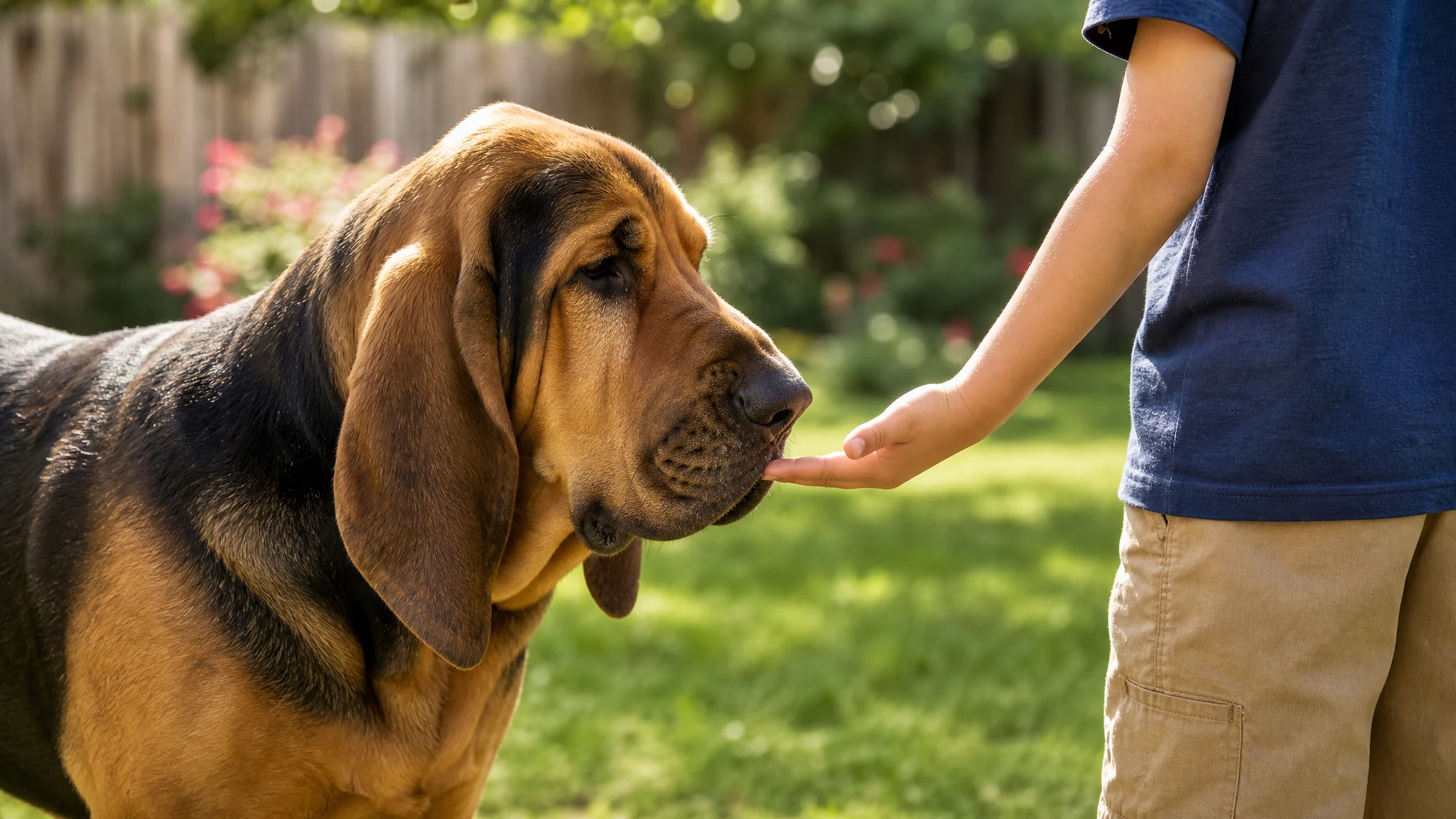
Ask a calm adult to stand still and let your dog choose whether to approach. The helper should avoid looming, reaching over the head or grabbing at the ears and face. Have them offer a treat from a flat, low hand, or toss it near their feet.
If your dog hangs back, let it. The UKC notes the breed can be somewhat reserved. Pressure usually makes a hesitant dog more hesitant. Give it time, reward any curious step forward, and end the session while it is still going well.
Repeat with different people over many outings: different sizes, voices, hats, umbrellas and walking styles.
4. Set the ground rules for children
This step covers both the dog and the kids. Teach children before the dog is ever in the room:
- Stay calm and use quiet voices.
- Do not hug, climb on or lean over the dog.
- Do not pull the ears, skin folds or tail.
- Leave the dog alone when it is eating, chewing or resting on its bed.
- Let the dog come to you, then pet gently along the shoulder or chest.
Those long ears and loose skin look like handles to a small child. A gentle breed can only be gentle for so long if it is being grabbed.
5. Supervise every child and dog interaction
Keep early meetings short and structured. Have the child sit, and let your dog approach on a leash. Hand the child a treat to toss on the floor so the dog associates kids with good things. Stop after a minute or two, and give your dog a break on its mat.
Active supervision means an adult is watching the dog and child, not just in the same room. Use a gate or pen when you cannot watch closely. This protects the dog as much as the child.
Watch your dog for signs that it wants out: turning its head away, lip licking, stiffening, yawning when not tired, or moving off. Respect those signals and end the session. If your dog growls, snaps or seems consistently uneasy around children, stop and talk with a qualified, reward-based trainer or your veterinarian. Those are not signs to push through.
6. Introduce other dogs on neutral ground
PetMD says Bloodhounds love being part of a pack and generally get along with other pets when socialized. That makes bloodhound with other dogs a hopeful pairing, but the introduction still decides how it goes.
- Pick neutral ground, such as a quiet street or open field, not your yard or home.
- Walk both dogs on leashes, parallel to each other and at a comfortable distance. Reward each dog for staying relaxed.
- Narrow the gap over several walks if both dogs stay loose and curious.
- Allow a brief, loose-leash greeting, then walk on. Keep it to a few seconds.
- If both are comfortable, move to a secure fenced space and let them share it, still supervised, with no toys, bones or food around at first.
Choose the other dog carefully. A calm, friendly, vaccinated adult dog is a better first partner than a rowdy one. Bloodhound strength and size mean rough play with a smaller dog can go wrong fast.
7. Keep the nose in mind
A scent trail can drown out everything else, including you and the new friend you are trying to introduce. PetMD points to the strong scent drive as a known challenge, which is why a leash or secure fence is not optional. Choose outings where you can control the environment, and give your dog time to sniff before asking for focus. Hill's notes that scent games and nosework count as exercise, so a sniffing break is part of the job, not a distraction from it.
8. Make it routine and keep it positive
Short, frequent, pleasant outings do more than a single big exposure. Keep adding variety: a new street, a visitor at the door, a friend with a child, a walk near a playground fence. Mix in quiet days. A tired, overstimulated dog does not learn well.
Tips for better sessions
- Use food your dog really loves. A distracted Bloodhound will turn down a dull biscuit.
- Keep sessions short. Hill's and PetMD both recommend short training sessions. End early on a good note.
- Exercise first. Hill's says Bloodhounds need at least an hour of physical activity a day, and PetMD describes moderate daily exercise. A dog that has had a walk is more settled when guests arrive.
- Reward calm, not just friendly. If you only reward excitement, you may get a dog that charges at everyone.
- Give the dog an exit. A gate, a bed in another room or a crate keeps the dog from being cornered.
- Be patient with stubbornness. PetMD describes the breed as independent and sometimes indifferent to training methods. Patience and good treats beat repetition and pressure.
Common mistakes to avoid
- Assuming a gentle breed needs no supervision. Even a patient dog can be pushed too far by a tired or rough child.
- Flooding the dog. Dragging a hesitant dog into a crowd can backfire. Go slowly.
- Using harsh corrections. Hill's and PetMD both say harsh methods backfire. Never use shock, prong or choke collars, alpha rolls or scruffing.
- Letting greetings run long. Long, face-to-face greetings on a tight leash can build tension. Keep them short and loose.
- Trying to train out the baying. PetMD says the deep howl or bay typically cannot be trained out, and the breed is one of the most vocal. Prepare neighbors and visitors, and reward quiet moments instead of expecting silence.
- Skipping the leash or fence. A dog following a scent can be gone before you notice.
- Ignoring body language. Small signals come before big ones.
What results to expect
With steady, positive practice, many Bloodhounds may become more relaxed around visitors, children and other dogs over time. You may notice a dog that recovers faster from surprises, takes treats in new places and settles on its mat while guests talk.
Progress usually comes in small steps and sometimes in setbacks. How fast it happens depends on the individual dog, its history and your consistency. No plan can promise a particular outcome. If your dog shows fear, stiffness, growling or snapping, or if you are not sure whether something is normal, ask your veterinarian first to rule out pain or illness, then consider a qualified reward-based trainer.
A simple weekly rhythm
- Practice the mat and focus cues daily in short sessions.
- Take two or three distance outings a week to watch people and dogs.
- Arrange one planned stranger or child meeting and one planned dog meeting, only if your dog is ready.
- Review your notes and pull back if you see stress.
Socialization is never really finished. A Bloodhound that keeps meeting the world in calm, rewarding ways tends to be easier to live with. Take it slowly, enjoy the droopy-faced charm, and let that nose have its sniffing time.